
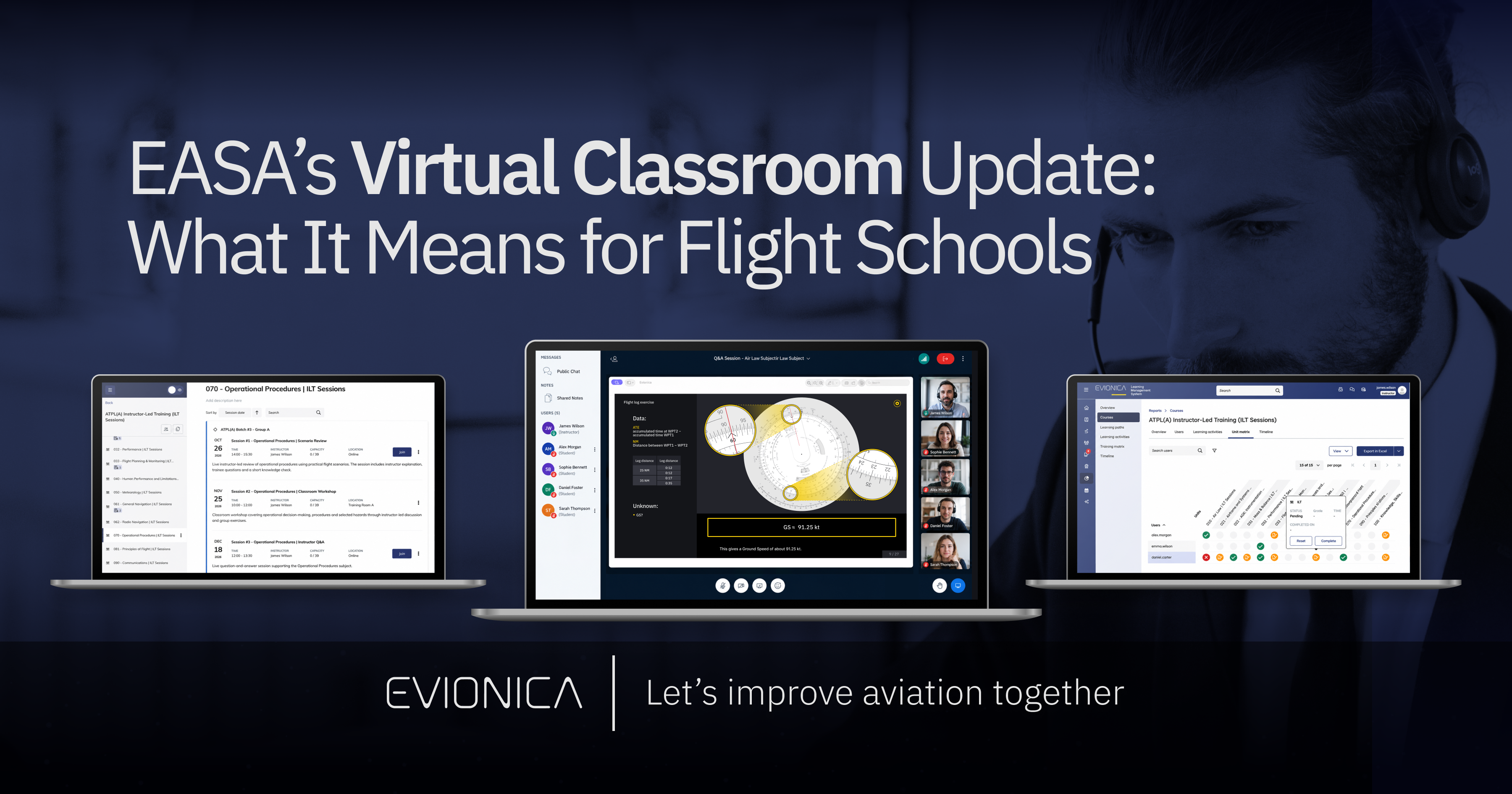
Can your theory lessons move online? EASA’s answer is now a confident yes, as long as the lessons are done properly. In its updated guidance on virtual classroom instruction and distance learning, EASA makes clear that live, Instructor-Led Training (ILT) delivered online is a recognised part of aviation training. It also sets out what flight schools need in place to make it work.
In this article, we explain the update in clear terms, list what you need to consider, and show how Evionica helps you do it.
What has EASA actually changed?
In August 2026, EASA published Issue 6 of its guidelines for virtual classroom instruction and distance learning. It’s the first full rewrite since the original versions were put together in 2020. In short, the update:
- Clarifies the terms, so everyone knows what counts as a virtual classroom and what doesn’t.
- Focuses on the live virtual classroom, now that it’s part of so many courses.
- Names the risks that virtual training brings and that schools need to manage.
- Gives schools a framework covering training effectiveness, instructors, trainees, equipment, attendance, assessment and risk management.
- Updates the role of National Competent Authorities (NCAs) in overseeing this type of training.
For flight schools, this is good news:
— EASA, Guidelines for allowing virtual classroom instruction and distance learning, Issue 6
So what counts as a virtual classroom?
You’ll see two terms in the guidance:
- Synchronous means “live”. The instructor and trainees are online at the same time, can see and hear each other, and can talk in real time. This is a virtual classroom.
- Asynchronous means “in your own time”. Recorded lessons, CBT and self-paced e-learning all fall into this group, which EASA calls distance learning.
Both are useful, but they aren’t interchangeable. A recorded lesson watched later doesn’t count as classroom instruction. If your programme requires classroom hours, those hours need to be live.
|
|
Distance Learning (in your own time)  |
| Instructor and trainees online together | Trainees study whenever suits them |
| Real-time questions and discussion | Recorded lessons, CBT, e-learning |
| ✅ Counts as classroom instruction | ❌ Does not count as classroom instruction |

Great news! So we can all go online and close the classroom?
Not quite. EASA expects a virtual classroom to reach the same training objectives and quality as a face-to-face one. Before you move a lesson online, there are some things you need to get right.

Trainees must take part, not just log in. Trainees must take part, not just log in. Being online isn't the same as being in the lesson. The instructor needs to see and hear each trainee and check that they're following, answering and contributing.

The equipment and the setting must be right. The equipment and the setting must be right. Trainees need a device and connection that let them see, hear and take part properly, and a quiet place to learn. A busy café isn't a classroom.
Instructors must be ready to teach online. Knowing which button shares your screen isn’t the same as teaching well through a screen. Keeping a remote group engaged is a skill in its own right.
You must know who is in the room. You must know who is in the room. Attendance needs to be checked and recorded, just as it would be in a physical classroom

Sessions need breaks. Lessons longer than 50 minutes without a break aren’t considered acceptable.
You need a plan for when the connection drops. This one sits with your school. Trainees need to know what to do, and you need to know how to record it and how the missed content will be made up.
You need to manage the risks. EASA lists specific risks that come with virtual training. Some sit with the school, some with the trainees themselves, such as sharing login details. Each needs to be assessed and managed.

You must be able to prove that the training works. This is the big one. Who decides whether your virtual classroom matches the quality of a face-to-face one? Your school must monitor it, and your NCA oversees how you do it.
So, what counts as proof? The research EASA points to in its guidance looks at a handful of practical measures:
- Performance: how well trainees do in assessments.
- Retention: how much of what they learn actually sticks.
- Engagement: how actively they take part.
- Satisfaction: how trainees rate the training themselves.
None of these is new to a flight school. The difference is collecting them consistently, over time, and comparing virtual sessions with classroom ones. That gives you evidence rather than impressions.
And some things are still best done in person
EASA is clear that virtual training doesn’t replace hands-on practical training. No one flies their first solo from a laptop. EASA also notes that combining virtual classroom, face-to-face training and distance learning can balance flexibility with effectiveness. In other words, it supports blended learning, where each part of the course is delivered in the way that suits it best.
How Evionica helps you get it right
| What EASA expects | How Evionica helps |
| Live ILT sessions | Run live virtual classroom sessions through BigBlueButton, which is built into our LMS, or link the external tools your school already uses, such as Microsoft Teams, Zoom or GoTo. |
| Active participation | Trainees arrive prepared because they’ve completed the assigned e-learning and knowledge checks beforehand. Instructors spend the session on discussion and questions, not on basics. |
| Attendance and identity |
Attendance is recorded in the LMS and linked to each trainee's training record. |
| Equipment and learning environment | Practical guidance on what counts as suitable equipment and a suitable place to learn, set out in our virtual classroom good-practice guide. |
| Instructor readiness | Instructor-focused courses and hands-on support to help your instructors feel confident teaching online. |
| Connection loss | Your school sets the procedure. Our virtual classroom good-practice guide helps you build it, and the LMS keeps clear records of who attended what. |
| Assessment and progress | Assessments, course progress and completion status for every trainee, all in one place. |
| Spotting who needs help | See at a glance where individual trainees struggle and which topics trouble the whole group, then target follow-up where it’s needed. That matters when many instructors are part-time airline pilots with little time to dig through data. |
| Training records | Completion evidence is ready whenever an auditor asks for it. |
| Risk management | A student Code of Conduct covering password sharing and account security, plus a risk checklist in our good-practice guide based on the specific risks EASA identifies. |
| Training effectiveness | Assessment results, progress data and trainee feedback in one place, so you can track performance, retention, engagement and satisfaction. Our good-practice guide explains how to measure them. |
Your school still decides which lessons go online, how they fit your approved programme, and what you agree with your NCA. You don’t have to work it out alone. We provide the content, the platform and the guidance to help you make those decisions with confidence.


Evionica helps flight schools bring live Instructor-Led Training, e-learning and assessment together in one connected blended learning journey that follows EASA’s guidance.
Ready to take your classroom online?
Find out how Evionica can connect your virtual classroom with aviation e-learning, assessment and progress tracking.

