News & Blog

Posts about:

Aviation E-Learning

Introducing Learning Paths: Training Designed for You

Building a structured pilot training programme takes careful planning. Every training environment is different — shaped by its standards, processes, instructors, and learners.

That’s exactly where Learning Paths come in.

As part of our new LMS interface, Learning Paths are now available — giving you a powerful new way to structure and guide training with clarity and intent. This feature is exclusive to the new LMS experience.


With our new Learning Paths feature, you can shape training structure around what matters to you — designing clear, tailored pathways that reflect your programme, your standards, and the way learning is delivered in your organisation.

This isn’t about fitting into a predefined model. It’s about giving you the flexibility to structure training your way — without sacrificing clarity or control.

Read More

Why distance learning in flight training?

Flight training has always demanded precision, discipline, and time, but for many, that still means hours in a classroom surrounded by printed manuals, PowerPoint slides, paper-based tests, and a clock ticking slowly on the wall as learners gaze out at the aircraft waiting on the tarmac, eager to take flight, yet having to sift through hundreds of pages of schematics, unfamiliar graphs, and dense text first.

This rigid structure has created challenges for learners and instructors alike: limited flexibility, commuting costs, little room to adapt learning to personal schedules, extra facilities needed for training sessions, and limited personalization in teaching methods.

Read More

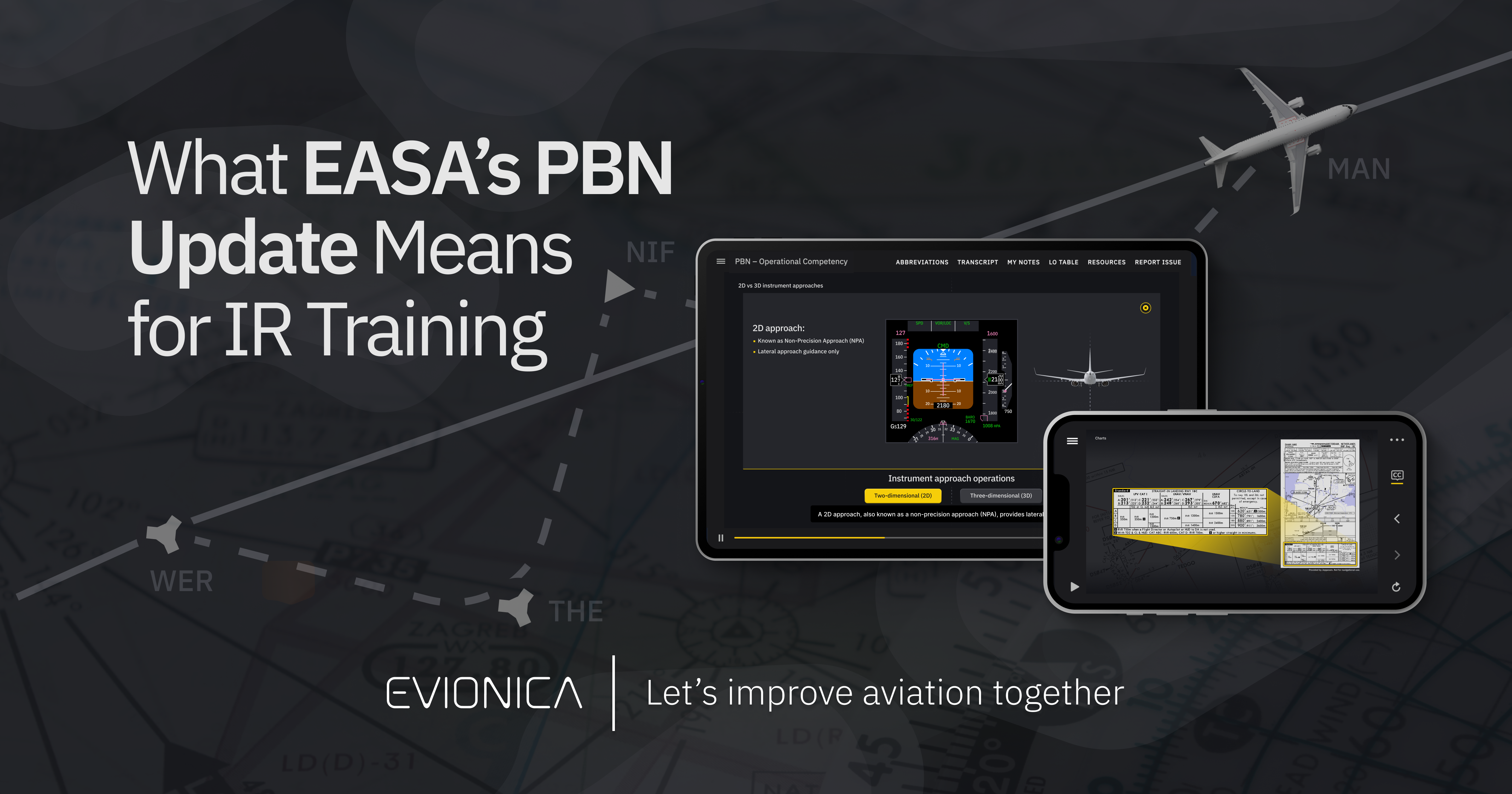
PBN Regulatory Clarification and What It Means for IR Training

Performance‑Based Navigation (PBN) has been part of European instrument flying for many years. Today, it is a core operational capability, used daily across controlled airspace and reflected in the privileges attached to the Instrument Rating (IR).

What is new — and highly relevant for training organisations — is the level of clarity EASA now provides on what PBN training within an Instrument Rating course should include. This clarification is formalised in AMC1 FCL.615(a) Amendment 13, which introduces a dedicated Acceptable Means of Compliance describing PBN training elements and syllabus expectations for IR training courses.

For Approved Training Organisations delivering IR training — including modular and integrated pathways — the key question is therefore no longer whether PBN is covered, but whether current training clearly reflects these defined expectations across theory, ground‑based practical training, and flight or FSTD exercises.

Read More

Aviation Leaders Join Forces to Modernize Pilot Training in Germany

Motorflugschule Egelsbach and IFR-Flugschule, two of Germany’s most respected flight schools, have partnered with Evionica to bring modern, immersive, and flexible training options to aviation students across Germany. Motorflugschule Egelsbach will be the official reseller of Evionica’s distance learning courses and a key player in the certification process for these courses in Germany, marking a significant milestone in evolving the way aviation training is delivered, while combining over 60 years of tradition with the cutting-edge technology Evionica is respected for globally.

Read More

CRM Inaction vs. CRM In Action: Why Crew Resource Management Matters

What connects Swiss cheese with decision-making and stress management? Clue: it's not the plight of an Alpine dairy farmer whose cows aren't yielding as much milk as in previous years. These are all things you will learn about as part of Crew Resource Management (CRM) training. Even though these might seem trivial, amusing, or at times bizarre, these are components of a CRM course that have saved many lives and improved overall safety since its formal development in 1979 and widespread adoption in the early 1980s.

Read More

What a Pilot Needs: Differences Training

I Trained on a Cessna 172 — Can I Fly a Diamond DA40?  You're an experienced pilot, yet you will never grow tired of that exhilirating feeling of soaring high in your Cessna 172. She's been a true friend to you, but your head has been turned by a brand-spanking new Diamond DA40, there's nothing stopping you from switching from one to another, is there? After all, they're both single-engine aircraft powered by piston engines and both include glass cockpit systems like Garmin G1000. So, can you just hop from one aeroplane to another? Legally and practically, the answer is: not without Differences Training. Let’s see what this involves and why it’s essential for pilots, instructors, and Chief Theoretical Knowledge Instructors (CTKIs) who oversee training standards.

Read More

What a Pilot Needs: Math and Physics

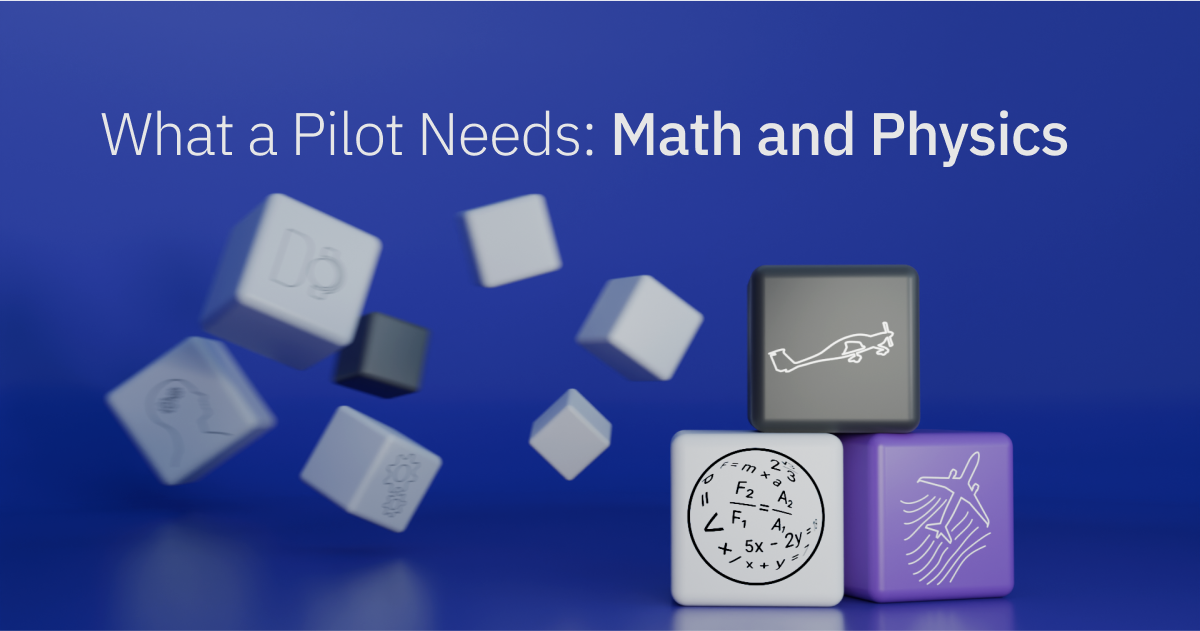
It's rare to find someone with a lifelong, unchanging ambition. Reality doesn’t just bite—it gnaws, chews, and swallows dreams whole. For example, this writer’s dream of winning Wimbledon was dashed by none other than Mr. Federer—not to mention an aversion to physical exercise and a love of fast food. Now, imagine the thoughts of a young person dreaming of becoming a pilot. They see themselves confidently striding to the cockpit, shoulders back, with a determined look and looking like a million dollars in their uniform. But oh! First, they have to face what they need to learn:

Read More

Tecnam and Evionica: Designing the Future of Aviation Training – Together

We are delighted to announce a long-term partnership with one of the world’s leading piston aircraft manufacturers - Tecnam. As part of this agreement, we will be designing the future of aviation training with an interactive learning platform for student pilots. The first models to be included in the agreement are the P2006T and P2008JC. Others will follow.
 
Read More